|
By Charlie Hoffs No one shows up at Arrillaga Late Night to save the world. Still—our choices at the buffet line have an impact on the planet. Trying to eat less meat is one of the most powerful individual actions we can take for the planet. You don’t have to go vegan to make a difference; every step counts. There are many levels of impact: Cutting out beef: Forgoing just one hamburger saves as much water as a three hour shower [1] [2], as much carbon-dioxide equivalent as a 90 mile drive [3] [4], and enough calories of grain to feed someone for 15 days [5] [6]. When you swap beef for pork and poultry, you reduces your diet’s GHG emissions by 14% and land use by 14% [7]. Going vegetarian: Going vegetarian reduces your food-related GHG emissions by 49% [7], water use by 36% [8], and land use by 48% [7]. Going vegan: A vegan diet releases 61-73% fewer GHGs and uses 76% less land than a diet including meat and dairy [9]. As students, our choices have a multiplier effect. Consistent trends in student preferences signal to dining hall staff that demand is shifting. R&DE (Residential and Dining Enterprises) is closely attuned to what students are and are not eating. If 100 more students choose falafel over chicken this month, they’ll order less chicken next month. As students, we have the unique opportunity to drive demand for more sustainable, plant-based food on campus. Every time we fill up our plates, we can choose to make a positive impact on the planet. Stanford is one of the easiest places to experiment with flexitarianism, vegetarianism, and even veganism. Dining hall menus are about 80% vegetarian, and 50% vegan [10]. Still, our food habits can be some of the most difficult to change. The key is going step by step. Take it slow and enjoy the process: going vegan at Stanford is fun and delicious! Here are some tips to send you off on your plant-based college journey:
Before taking anything off the menu, start by adding new vegan dishes you love. Try something new at the dining hall—kimchi tofu stir fry, chipotle black bean chili, chickpea curry, falafel, hummus, pita, a bean and rice burrito, or some classic roasted sweet potatoes. Check the Stanford Dining Facebook page to find out when you can look forward to your favorite meals (https://www.facebook.com/stanforddining). If you’re craving a juicy plant-based burger, grab an Impossible Burger at TAP. In fact—you can find Impossible Burgers at 9 different restaurants within a 2 mile radius of campus! My personal faves are vegan Cookies and Cream from Salt and Straw or Soy Mint Chocolate Chip at CREAM.
Merely cutting out beef has a huge impact. Swapping for chicken or fish slashes your environmental footprint and can help ease the transition off red meat. Or, if you find yourself at the hamburger bar, try a quinoa burger. Beef entrees usually don’t take center-stage in Stanford dining halls for sustainability reasons, so you might be surprised how easily you forget this craving.
Many of your favorite breakfast foods might be vegan—by accident! A bowl of oatmeal with some brown sugar and nuts. Toast with peanut butter and heaping bowl of fruit. Hash browns. Potatoes. A bowl of cereal with almond milk. A green smoothie. It’s easy to switch over to vegan breakfasts; you might be doing it already.
Give it a test run and see how you feel. Let go of any commitment anxiety and treat it like a self-experiment. During your test run, ask yourself what you like and how it makes you feel. (P.S. The only supplement you need to take is B12; it’s the only vitamin that’s difficult to find in plant-based foods. Other than that, a vegan diet gives you all the nutrition you need!) Four years ago, I tried what I thought would be one month of pescetarianism. One thing led to another and now I’ll be vegan for my whole life. Good luck—you’ve got this! Your plant-based choices will have a far-reaching impact on campus sustainability and the planet. You are doing your health a tremendous favor. You are saving animal lives. You are part of a movement. We’d love to hear your thoughts! What do you think about veganism? Eating plant-based in college? Do you have any tips for eating green at Stanford? Please email [email protected] with your follow-up questions or comments. Sources: [1]https://www.researchgate.net/publication/254859487_The_green_blue_and_grey_water_footprint_of_farm_animals_and_animal_products [2] https://www.home-water-works.org/indoor-use/showers [3] https://link.springer.com/article/10.1007/s11367-012-0434-7 [4] https://www.epa.gov/greenvehicles/greenhouse-gas-emissions-typical-passenger-vehicle [5] https://fdc.nal.usda.gov/ [6] https://wriorg.s3.amazonaws.com/s3fs-public/Shifting_Diets_for_a_Sustainable_Food_Future_1.pdf [7] https://wriorg.s3.amazonaws.com/s3fs-public/Shifting_Diets_for_a_Sustainable_Food_Future_1.pdf [8] https://waterfootprint.org/media/downloads/Hoekstra-2012-Water-Meat-Dairy_2.pdf [9] https://science.sciencemag.org/content/360/6392/987 [10] https://rde.stanford.edu/dining/vegetarian-vegan-dining [11] https://www.pnas.org/content/111/33/11996 Here is a graphic which exemplifies how much water is used in the production of beef: 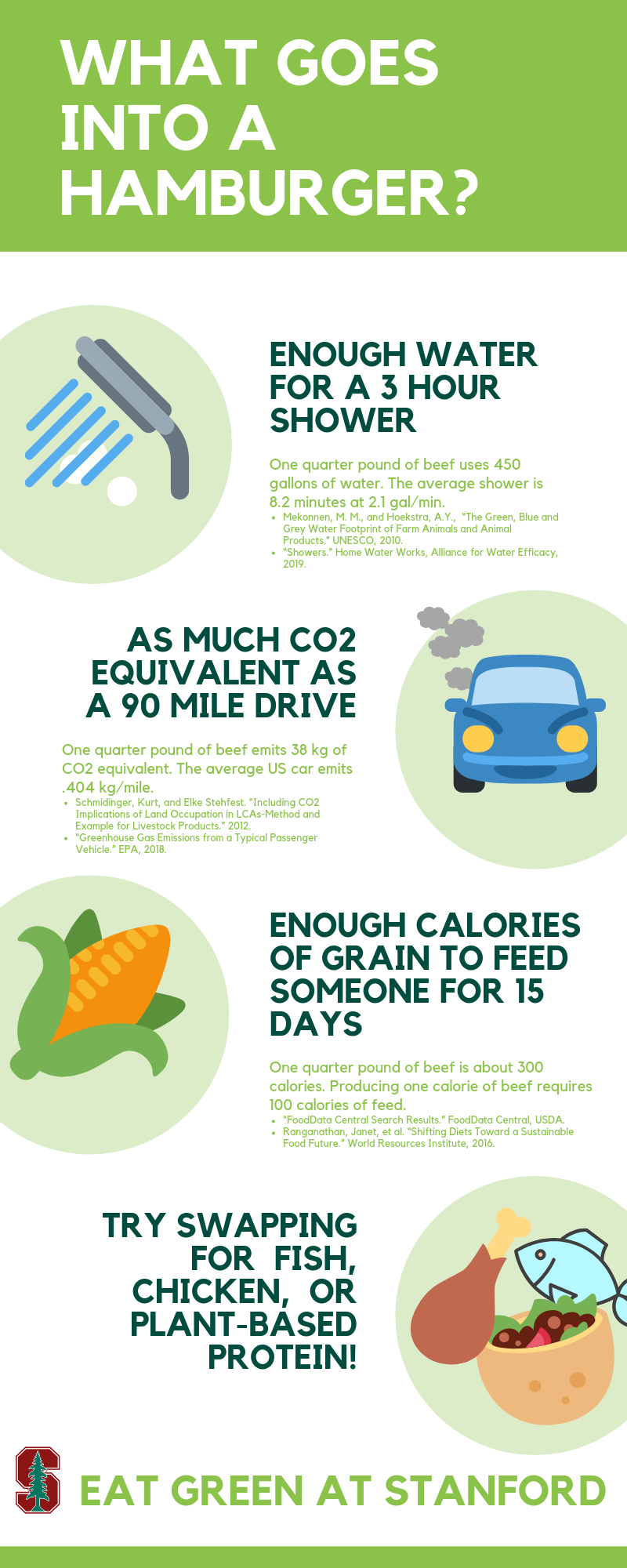
0 Comments
Leave a Reply. |
Welcome to our blog!This is a forum for students to share their writing on intersectional environmental topics, curated by Students for a Sustainable Stanford. Writers of all backgrounds, abilities, and perspectives are welcome. Archives
|
 RSS Feed
